
Worthington-Simpson was one of the most influential British manufacturers of pumps and pumping equipment in history with roots stretching back to the late 18th century.
Over nearly two centuries, the company played a major role in municipal waterworks, industrial fluid handling and large-scale engineering projects across the United Kingdom and beyond.
Pumps were the Simpson family business
The story begins with Thomas Simpson, an engineer who established a steam engine workshop around 1785. His work was connected with early water supply systems such as the Lambeth Waterworks in London.
When Thomas was no longer able to run things, it was over to his fourth son, James Simpson, to continue the fledgling family business.
In 1828, James built the first slow sand water filter bed in London. It was a milestone in public health engineering in the UK.
Now considered one of the finest minds in the country when it came to public water, he also provided consulting and designs for waterworks in cities like Bristol, Aberdeen and even further afield in Copenhagen.
Whilst that was his perhaps his greatest achievement, three years earlier and James was involved in another big moment in the history of water supply within the UK.
He formed Simpson and Thompson in 1825, a manufacturing company focussing on steam engines and pumps. Later reconstituted as James Simpson & Co, they built pumping engines and machinery that began to replace older beam engine technology in municipal waterworks.
Simpson makes a strategic partnership with Worthington
In 1885, James Simpson & Co discovered a company in the United States were making a superior pump design. And so they signed an exclusive agreement with the Worthington Pumping Engine Company to manufacture Worthington pumps for the UK and colonial markets. It was the start of a long-lasting connection between the two firms.
The partnership was successful enough for the two companies to merge in 1903. James Simpson & Co and the London branch of the Worthington Pumping Engine Company became Worthington Pump Co. This union blended British engineering tradition with advanced American pump technology.
In 1917, the merged business was renamed Worthington-Simpson Ltd. It solidified Worthington-Simpson as a leader in pump design and manufacture with the name still recognised worldwide over a century later.
The growing influence of Worthington-Simpson in the 20th century
During the early to mid-20th century, Worthington-Simpson supplied pumping equipment for major waterworks projects throughout Britain.
They built large horizontal pumping engines, triple-expansion steam engines and direct-acting pumps for works at locations such as Croydon, Bournemouth, Wisbech and Brede in East Sussex.
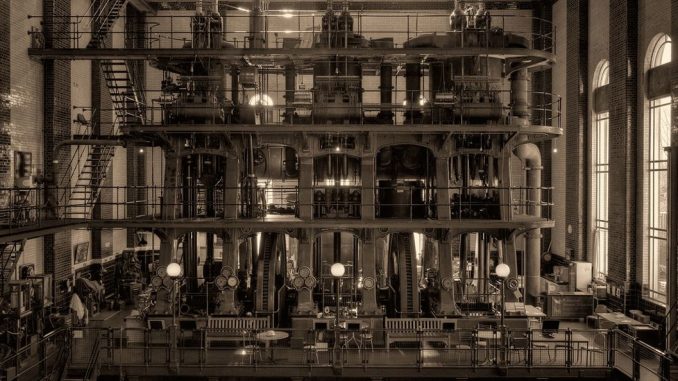
One of their most remarkable achievements was at the Kempton Park Water Works near London. Two massive Worthington-Simpson triple-expansion steam pumping engines powered Kempton Park and were amongst the largest of their type ever built.
The engines went into operation in 1928, pumping tens of millions of gallons or water every day. A combination of being brilliantly engineered and some careful Worthington-Simpson pump repair applications kept both engines in service until the 1980s.
Worthington-Simpson pumps even found military use in World War II. A Rolls-Royce–powered Worthington-Simpson unit was adapted into a Heavy Pump Unit flamethrower, capable of projecting thousands of litres of liquid per minute.
The company expanded into other areas after their dalliance with weaponry. By 1961, their range included compressors and heat-exchange equipment with over 1,300 employees working for the business.
Mergers, acquisition and legacy
Worthington-Simpson remained independent until 1969, when it was acquired by the multinational Studebaker-Worthington following a series of corporate manoeuvres.
Subsequent changes in ownership saw the business pass through various hands. It was acquired by Dresser Industries in 1985, merged into Ingersoll Dresser Pumps in 1992 and ultimately became part of the Flowserve Corporation — a global leader in flow control products.
Today, the Worthington-Simpson name survives in the heritage of Flowserve’s pump portfolio. There also remain many historic Worthington-Simpson installations, some of which are still in operation or preserved in museums. This longevity testifies to the engineering excellence of the company.
Enduring engineering heritage of Worthington-Simpson pumps
Even though the original company no longer exists as a standalone entity, Worthington-Simpson pumps remain widely respected for their durability and engineering quality.
Many older installations still operate and specialist companies continue to refurbish and maintain these historic pumps.
With spare parts no longer manufactures, repairs can be challenging. But Worthington-Simpson pumps are so well-loved that enthusiasts always find a way.
From municipal water supplies to powering industrial infrastructure, the history of Worthington-Simpson reflects both the evolution of pump technology and the broader development of modern engineering over nearly 200 years.
Leave a Reply