
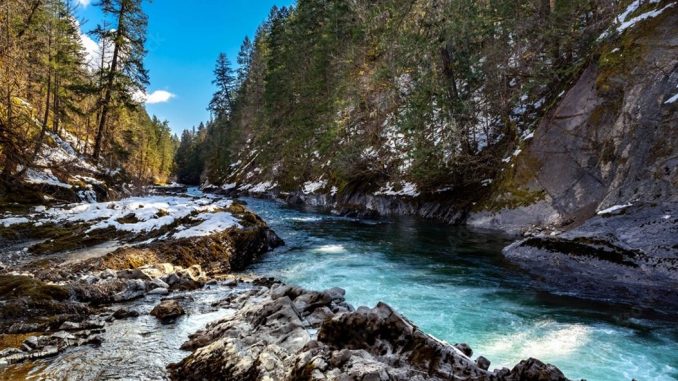
The water pipe network supplying part of Vancouver Island in Canada requires emergency repair expected to cost in the region of $4.5 million after being left exposed by river scour.
Two major pipelines were discovered in a “significant scour hole” beneath the Cowichan River, just south of the North Cowichan and Crofton district on the west of the island.
Erosion has lowered the riverbed by about one metre in total. It has also compromised the stability of a dyke on the south of the river which protects an important highway called Boys Road, a wastewater treatment facility and land belonging to the Cowichan Tribes from flooding.
The exposed pipes supply drinking water to around 22,000 residents as part of a network buried one to two metres below the riverbed.
A third pipe has also been deemed at-risk of exposure. This force sanitary main transports wastewater from the Cowichan Valley regional district and is located just downstream of the two water pipes.
What caused river scour on Vancouver Island?
Experts believe the severity of the river scour had been heightened by a combination of factors.
Whilst 2025 so far has been a drier year than normal for British Columbia, Vancouver Island experienced a couple of heavy storms during the Spring. Prior to that, it was hit by a bomb cyclone in November 2024 which brought high winds, flooding and snow.
Such extreme weather events cause rising water levels in rivers, increasing flow speed. Faster rivers are more powerful, enabling them to move significant amounts of gravel and sand from the riverbed. Stronger rivers will also carry more debris such as large logs, causing further scour.
Lastly, the exposed pipes were located around 875 metres downstream from piers supporting Trans-Canada Highway bridges. Piers enhance river scour by diverting water flow and can become compromised themselves should the river remove sediment from around their foundations in a process known as bridge scour.
The river scour pipe repair process
Several different processes have been developed to protect pipework exposed by river scour. Scotia Gas Networks in Scotland have recently launched a programme to reinforce gas pipes exposed in riverbeds across the country by wrapping them in composite pipe repair bandages.
Maintenance workers enter the water, access the pipe and apply the bandage. The water-activated resin sets rock-hard in minutes, creating a 6mm thick, impact resistant shell protecting the pipe against any impact damage caused by scour.
The $4.5 million river scour pipe repair for Vancouver Island is set to be much more complex. Emergency construction was approved to protect the pipes and dyke as a matter of urgency, before either could be breached to cause water supply issues or flooding.
It will take place during a window approved by Fisheries and Oceans Canada and the Ministry of Environment to limit the risk to trout and salmon in the river.
Isolation berms will be used to help excavate and removal gravel from the riverbed. Crews will then lay a new gravel cushion over the expose popes, install layers of stones to form sills and reinforce the dyke.
Whilst river scour might have forced the district into carrying out this particular pipe repair and refurbishment application, long-term plans were already in place to improve the resilience of the network.
The Boys Road Trunk Main replacement project will upgrade ageing water infrastructure with larger pipes to improve reliability and increase capacity.
Work is due to commence on the rest of the project once the exposed river pipes have been attended to.
Leave a Reply