
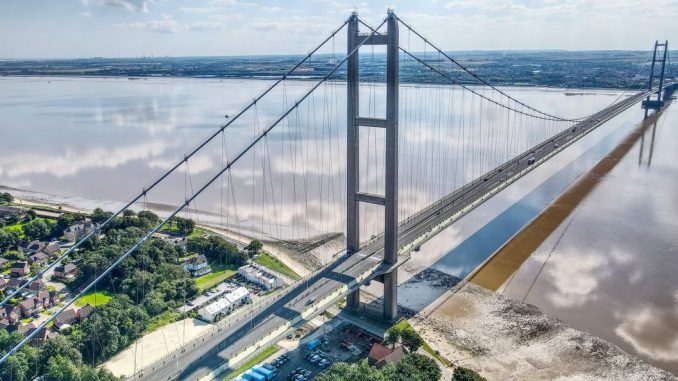
In December 2020, a new artery serving the energy infrastructure of the United Kingdom began pumping gas beneath one of the country’s most iconic river. Five years on and the Humber Gas Pipe remains an engineering marvel.
There are several reasons why we have decided to get all bleary-eyed over the Humber Gas Pipe to mark its fifth birthday. The first is that it is a rare infrastructure project in the UK which actually went from planned to completion.
Whereas ambitious plans like HS2 and a new runway for Heathrow have become mired in problems, the Humber Gas Pipe was constructed relatively quickly and with minimal fuss.
From a pipeline perspective, it mixed daring engineering with innovation and collaboration. The Humber Gas Pipe had to overcome logistical and environmental challenges at the start, followed by the Covid-19 pandemic hitting just as the project entered its final stages.
At the same time as restrictions meant the only way you could buy a pint in a pub was along with a scotch egg, those working on the Humber Gas Pipe still managed to complete the project and bring it online.
But most importantly, it helped secure the energy security of not just North East England but the whole country. All of which makes it worth celebrating.
The Humber Gas Pipe – a national necessity
The original gas pipeline which crossed the Humber Estuary was built into the riverbed in 1984 using trench laid installation.
What nobody knew at the time was the estuary’s extreme shifting tides and heavy commercial marine use meant an installation process suitable for other pipelines would be vulnerable to conditions in the Humber Estuary.
By 2009, underwater surveys flagged the pipe for potential catastrophic failure. It had been left so damaged by tidal scour and erosion that not even a river pipe protection programme could save it.
With the original pipeline feeding up to 25 percent of the UK’s gas demand, it became obvious a replacement was needed as a national necessity.
A bold vision to bore under a busy estuary
In 2016, the River Humber Gas Pipeline Replacement Order authorised National Grid to build a new pipeline beneath the estuary.
It was a bold idea. Bore a tunnel roughly 30 metres below one of the UK’s busiest waterways and insert a high-pressure steel pipeline capable of reliably transporting natural gas for decades to come.
The £150 million contract was awarded to a joint venture of Skanska UK, Austrian construction company PORR Bau GmbH and energy infrastructure specialists A.Hak from the Netherlands.
An international consortium which brought together tunnelling, civil and pipeline expertise from across Europe for the ambitious task.
Tunnelling under the Humber
The central piece of the project was a five kilometre tunnel bored 3.65 metres in diameter and running from Paull in the East Riding of Yorkshire to Goxhill in north Lincolnshire.
A specially constructed tunnel boring machine (TBM) commenced work in April 2018. Affectionately named Mary, the machine chipped through chalk formations and glacial deposits beneath the estuary with remarkable precision.
After approximately 18 months underground, the machine reached its destination. A testament to meticulous planning and operational discipline.
The tunnel was completed in late 2019. It was not simply a passageway. It was designed to last 120 years, far outliving the steel pipe to be nestled within.
Hydraulics, water and world records
Boring the tunnel was only the start. The most visually striking phase of the build was the hydraulic insertion of the pipeline itself.
A little over one metre in diameter, the steel pipe was prefabricated in sections. It was then welded into lengths over 600 metres long and hydraulically thrust into the water-filled tunnel at a controlled pace of around one metre per minute.
Enough treated water to fill 16 swimming pools had been flooded into the tunnel beforehand, facilitating the smooth insertion of the multiple pipe strings.
On July 9th 2020, the final piece of the five kilometre pipeline was fitted in place. It earned a Guinness World Record for the longest hydraulically inserted pipeline in the world.
It was an emblematic moment not just for the Humber Gas Pipe project team but for British engineering as a whole and the other European companies involved.
Turning the taps on the Humber Gas Pipe
The Humber Gas Pipe went online for the first time in December 2020, ensuring a secure supply for up to a quarter of the nation’s demand.
From its conception as a vital replacement to its final operational status, the Humber Gas Pipe exemplifies how infrastructure projects can balance risk, innovation and collaboration.
Not only did it replace an ageing asset at risk of failure, but it also set new benchmarks in tunnelling and hydraulic insertion techniques.
The Humber Gas Pipe five years on
Five years after the taps of the Humber Gas Pipe were turned on and it continues to quietly perform its role as a backbone of the UK’s gas network.
Its construction demonstrated how conventional energy infrastructure could be delivered with minimal surface disruption, remarkable safety performance and an eye toward longevity.
As the UK simultaneously expands renewable capacity and explores low-carbon alternatives like hydrogen, the Humber project stands as a reminder that when engineering ambition meets careful stewardship, the results can be far-reaching and enduring.
Leave a Reply