
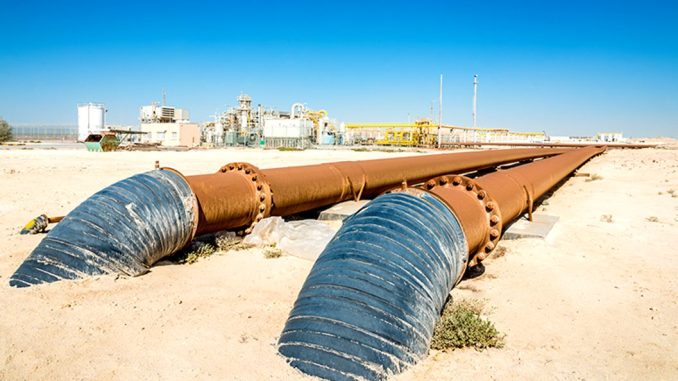
Saudi oil giant Saudi Aramco have dramatically increased crude oil exports through their East–West pipeline after the US-Israel war with Iran closed the Strait of Hormuz, rerouting oil supplies across the kingdom in an effort to avoid one of the world’s most critical maritime choke points.
According to the House of Saud website, crude oil flow through the pipeline has tripled from roughly two million barrels per day to nearly seven million barrels per day – its emergency operating maximum.
The modest Red Sea port of Yanbu was processing fewer than 800,000 barrels daily in February. Since the week starting Monday 2nd March 2026, five supertankers loaded with roughly 10 million barrels have departed westward as Saudi Arabia scrambles to preserve exports to global markets.
Constructed in 1981, the East-West pipeline runs for 1,200 kilometeres across the width of Saudi Arabia from the Abqaiq oil field to Yanbu.
It was originally built during the Iraq-Iran War to allow Saudi oil exports to bypass the Strait of Hormuz amid fears shipping might be cut off.
The pipeline has rarely operated at full crude oil capacity until now. In the past, it has even been converted to carry natural gas.
Despite its age, the East-West pipeline remains in good working condition. This is not really a surprise; pipe repair and maintenance in Saudi Arabia is world-leading.
Saudi Aramco quick to activate East-West oil pipeline to avoid Strait of Hormuz
Saudi Aramco worked rapidly to increase capacity through the East-West oil pipeline after Iran announced the closure of the Strait of Hormuz. The blockade came amid escalating military tensions with the United States and Israel.
Iranian naval forces warned commercial shipping against entering the waterway. Effectively halting traffic through the narrow corridor that normally carries around one-fifth of global oil supplies.
The sudden disruption sent shockwaves through international energy markets. Benchmark crude prices climbed sharply on fears of prolonged supply shortages.
To maintain exports, Aramco activated emergency contingency measures centred on its East–West Crude Oil Pipeline – known as Petroline.
“The largest emergency rerouting operation in global oil trade history”
Petroline has fulfilled a role before as the kingdom’s primary strategic alternative during previous regional crises.
But industry analysts describe this increase in pipeline utilisation as one of the largest emergency rerouting operations in the history of global oil trade.
“Saudi Arabia effectively redirected the majority of its export system westward almost overnight,” one Gulf-based energy consultant said. “The jump from two million to seven million barrels per day shows how critical this infrastructure has become.”
Satellite tracking and tanker schedules showed increased activity at the port of Yanbu as exporters repositioned cargoes for European and Asian customers.
Meanwhile, traffic through Gulf export terminals fell sharply as insurers and shipping companies pulled vessels away from the Strait of Hormuz and wider conflict zone.
Despite the surge in throughput, analysts warned that the pipeline still cannot fully compensate for a prolonged closure of Hormuz.
Gulf oil producers like those based in Saudi Arabia’s oil capital Dammam collectively export far more oil through the Strait than available bypass pipelines can handle.
Shipping executives also cautioned that insurance premiums and security concerns could continue disrupting trade even if the waterway reopens in the near future.
The crisis has renewed international focus on the strategic vulnerability of the Strait of Hormuz, long regarded as the world’s most important energy choke point
For decades, Gulf states have invested billions in pipelines and alternative export routes to reduce dependence on the narrow passage. Despite this, experts say no existing infrastructure can fully replace it.
Even so, Aramco have helped prevent a more immediate supply shock with their rapid expansion of pipeline exports. In doing so, they have offered global markets a temporary buffer as tensions continue to escalate across the region.
Leave a Reply